
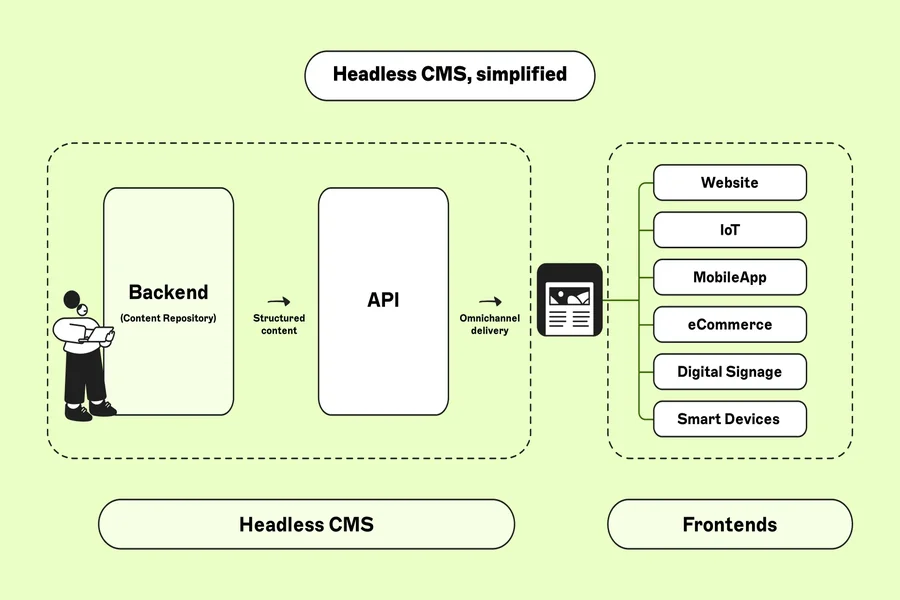
As eCommerce continues to evolve, so too do consumers demand seamless connections, personalized experiences, and omnichannel engagement. Composable architecture offers the opportunity for brands to integrate certain components and software to create a malleable digital experience. However, a composable solution only works if the components are integrated and aligned appropriately. This is where headless CMS and headless commerce enter the discussion. These two platforms enable brands to craft content and product experiences that engage, grow, transform, and sell limited only by imagination rather than legacy systems.
Enjoying the Advantages of a Decoupled Mindset
The underlying philosophy of headless commerce and a headless CMS is the same decoupling the backend from the frontend. With an arrangement by which content and commerce data are managed independent of one another but delivered to any frontend or device via API, businesses utilizing both can have more opportunities to create a wholly immersive experience that integrates storytelling and discovery. Create and manage content faster with Storyblok to streamline how campaign narratives and product data come together in unified digital experiences. For example, in the content management system, the content team can generate campaign efforts, sales, and branding stories. The commerce side runs product information, pricing, and inventory. Each system does what it does best, unfettered by the other yet still connected.
Enhancing the Customer Experience with More Relevant Experiences
Information about a product won’t demonstrate its worth unless it’s provided with proper context. Not just information is needed, but experience. When marketers have access to a headless CMS with commerce, they can layer product listings with meaningful context that impact the customer whether from customer stories, how-to videos or articles (how-to, brand stories). Ultimately, this is to help customers interact properly and positively with products in their lives. When they are about to make a purchase, those additional helpful elements show that the product is solution-oriented. The better the reviews, the better the rankings and multiple pieces of content can increase SEO traction.
Delivering Consistent Experiences Across Digital Experiences
Omnichannel engagement is expected. Users listen to podcasts while they browse on desktop and scroll on mobile. They may interact via kiosks and frequently cross-reference marketplace listings. With a unified headless CMS and CMS solution, companies can provide consistent experiences across any channel and without channels. Because both systems are headless and decoupled from any frontend, developers can push content and product data to any interface and smart devices/PWAs without missing a beat of consistency. Whether transaction-driven or message-driven for sales inquiries or product questions it’s essential that no matter where a user interacts, product and brand messaging is consistent.
Generating Workflow Efficiencies for Content and Commerce Teams
Whether a brand has a dedicated content team full-time or a dedicated set of product managers focused on merchandising, there are workflow efficiencies to be had when a headless CMS integrates with a headless commerce solution. Content editors no longer have to work with product authors and vice versa; they both have their own working tools to operate better suited for each solution but still drive toward the same business goals. The CMS will help content creators build articles, blogs, landing pages, branded graphical promotions and storytelling. The commerce solution will host SKU creations, pricing mechanisms, and inventory levels. When content and commerce solutions integrate, however, updates to products or new promotional activities can be pushed live across the board without cross-department teams waiting on each other to respond and potentially creating compliance errors.
Supporting Flexible Personalization and Real-Time Experiences
Personalization is key in any e-commerce experience. With a headless CMS and headless commerce integration, brands can ensure that both content and products render based on what’s best for the customer at all times. The headless CMS can provide dynamic content blocks based on predetermined segmentation just as the headless commerce can provide facet-based pricing or featured categories. When connected via APIs, the two solutions can support experiences that render in real-time local promotions can display on the commerce storefront while being mirrored in promotional articles or blogs during the same customer session. Bundles can appear in guided selling experiences as well as within how-to pieces to provide more upsell opportunities.
Enhancing Performance Through Rapid Delivery Systems
Speed is of the essence when it comes to e-commerce solutions. When a brand has a headless CMS accessed through a headless commerce backend, it opens the door to some of the fastest running frontends that load quickly and scale on demand. Since both sets of content are delivered through APIs, developers can choose fetch modes, implement CDN caching, static site generation and/or server-side rendering which gives a brand a competitive edge when it comes to performance. It lowers load times and improves Core Web Vitals for responsive experiences even when traffic booms. The quicker the interactions, the better the customer experience, conversion rates, and SEO rankings.
Supporting Global Growth and Localization
For brands that sell worldwide, being able to render localized content and merchandising info is essential. A headless CMS can support multilingual offerings and geo-targeted messaging while a headless commerce solution can cater to geo-specific pricing, taxation and inventory. Once they are linked, the two solutions work seamlessly to deliver an accurate, advantageous experience for shoppers no matter how many regions are involved. A shopper in France sees one version of the item in French, Euro pricing and local shipping options; an American sees the same item in a different version with a completely different set of parameters. This kind of localization is done at scale and enables international brands to operate with an eye to detail in smaller markets.
Plugging Into a Composable Tech Stack
A headless CMS and commerce solution fit like a glove into a contemporary, composable tech stack. They connect easily to analytics solutions, CRM tools, personalization, search, and more. By connecting solutions through defined APIs and event-based workflows, brands enjoy a genuinely composable environment. Developers can choose best-of-breed solutions and either connect via middleware or orchestration layers while simultaneously expanding the tech stack over time without throwing any other part of the puzzle off-kilter. This composable ability means that the digital foundation remains fluid, responsive, and in-tune with ever-changing innovation needs.
Innovating Faster Thanks to Developer Freedom
The new integrations made possible by a headless CMS and commerce solution provide Development teams with serious flexibility and this is one of the best reasons to go headless. They’re no longer tied to what’s possible via built-in page builders or what a monolithic application mindset dictates; they can create fully-custom experiences with access to contemporary front-end frameworks like Next.js, Nuxt, React or Vue. They can launch functionalities faster, iterate on new layouts, leverage performance accelerators and utilize micro-rollouts. That quickness and flexibility fosters a culture of continuous innovation around content and commerce for diverse end-user wants and needs.
Enabling On the Fly Campaigns and Content Changes
In digital sales, everything is time-sensitive; flash sales need to launch at a moment’s notice, newsjacking can evaporate within an hour, and seasonal offers need to be changed frequently. The ability to publish content at a moment’s notice gives merchants a leg up. Integration between a headless commerce solution and headless CMS enables marketing teams to engage campaigns on the fly, everything from promotional graphics, pre-scheduled product displays, landing pages, and teasers can be implemented across environments. With API-driven content, to publish means to publish instantly, meaning customers always see what’s updated, what’s available and what commerce-driven activities are live.
Merging Content Creation and Conversion Efforts
Typically, content creation efforts and conversion endeavors run independently of each other. Still, coupling a headless CMS with a headless commerce solution tightly binds them together. Brand-centric pieces of editorial content, tutorial how-to’s, customer testimonials and stories can all be situated along the customer journey to reduce path-to-purchase friction, increasing buyer confidence. Developers can design experiences that reveal certain content types on category pages, within shopping cart panes, or post-completion of a transaction to engage customers while encouraging action simultaneously. Instead of having content that works only for branding efforts independently available, this opportunity allows for previously isolated information to help branding efforts and pragmatic business goals.
Creating Redundancy and Failover for Resilient Systems Architecture
When a commerce experience goes down, revenue is lost, and customer sentiment drops. Because a headless architecture separates the CMS from the commerce engine, companies can create scenarios for failover and redundancy for resilient systems. For example, if one service goes down, say, a product inventory API, the frontend can still render usable pages instead of blank spaces because headless CMS can cache or hold fallback information in placeholders. With systems not entirely dependent on each other, the chance for an entire experience to go down just because one part is unavailable greatly diminishes, reducing risk and increasing consistency across digital experiences.
Future-Proofing Digital Infrastructure for Evolving Commerce Models
Digital commerce is only going to expand and trends are already beginning to emerge for the future. Expect more subscription services, digital-only products, livestream shopping and augmented reality. With a headless CMS tied to a headless commerce solution, it’s easy to pivot and try new things. When new channels and transactions are introduced, the API-based architecture allows companies to bolster their customer-facing opportunities, plug in new technologies or change fulfillment options without needing to rebuild the back-end infrastructure. Companies will be poised to handle anything.
Conclusion: A Unified Approach to Content and Commerce
The headless CMS and headless commerce solutions must integrate to achieve the unified, extensible, and effective digital commerce experiences needed in an ever-increasing omnichannel world. Customer journeys are no longer linear. Customers may find a product on social media, research it on a third-party marketplace, or seek more information on the brand’s website before adding it to their shopping cart on a mobile app. They may follow the same brand on Facebook and Instagram or participate in an AI chatbot within a metaverse. Regardless of the situation, companies need to ensure that the appropriate blend of content and commerce exists at any stage, at any place, at any time. Therefore, a single solution that can extend the benefits of cohesive content and commerce across all potential intersection points is critical for success as it provides efficiencies.
Headless commerce solutions lay the groundwork for decoupled, best-of-breed transaction capabilities by making all required functionalities accessible through APIs while supporting service layer integration through additional tools, as warranted. Similarly, a headless CMS grants all marketing teams versatile content creation and branding options deployable similarly through APIs as needed. Therefore, when brands use the two solutions together, they can utilize two separate systems successfully operating independently from each other without sacrificing either.
Competitive advantage and powerful narrative require a cohesive experience through commerce and content. Static product descriptions no longer drive transactions on their own. Marketing teams need to provide immersive experiences across web pages, digital intersection points, storefronts, payment gateways, and shipping pathways. A headless CMS allows marketing teams to use templates for dynamic elements blended seamlessly through branding efforts and virtual offerings without overlap. The headless commerce solution handles transactional needs when payments are due, return policy compliance exists, and inventory is received. But integrating both provides a rapidly deployed experience, with data syncing across both systems to ensure cohesive transaction opportunities.
In order to stand the test of time and achieve golden outcomes of digital agility, the winners must successfully integrate for an experience-driven solution of Commerce and content tethered together yet remaining unique, as well. Organizations mustn’t just keep pace they need to take the lead on omnichannel digital transformation efforts that deploy smarter, more relevant and effective experiences for every consumer-turned-casual browser-turned-loyal customer.